
Online sourcing platforms make it easier than ever to discover suppliers in China. They do not, however, remove the need for careful commercial checks. A company presented as a factory may manufacture the goods itself, outsource some production, or operate mainly as a trading business connecting buyers with other factories.
None of these models is automatically unsuitable. A capable and transparent trading company can provide valuable coordination, especially when an order contains several products. The important point is to understand who you are dealing with, where production takes place and who is responsible when specifications, timing or quality need attention.
Why the distinction matters
Knowing the supplier’s actual role helps you evaluate pricing, production control, communication and accountability. If several undisclosed parties sit between the buyer and the production line, technical changes may take longer to communicate and responsibility can become unclear when something goes wrong.
Direct factory contact is not always the cheapest or most practical option, and a business licence alone cannot prove production capability. The aim is therefore not simply to remove every intermediary. It is to establish a transparent supply arrangement that matches your product, order size and risk level.
1. Request the company’s business registration documents
Begin by asking the prospective supplier for its current business licence and full registered company details. Compare the legal name, registration number, registered address, establishment date and stated business activities with the information used in quotations, contracts and email signatures.
Manufacturing-related activities in the registration can support the supplier’s claim, while wording focused mainly on sales or trading may suggest a different business model. Registration wording is only one indicator and should be considered alongside the other checks below.
2. Verify the company independently
Do not rely only on an image or PDF sent by the supplier. Where possible, confirm the registration number and current company status using an appropriate official registry or an independent local professional. Check that the information matches exactly; small differences in English trading names can sometimes hide important differences in the underlying legal entity.
3. Assess the registered and operating addresses
Ask whether the registered address is also the production location. A factory site would normally be consistent with industrial activity, while an office building may indicate that manufacturing happens elsewhere. Maps, publicly available business information and local checks can help identify obvious inconsistencies.
This does not replace a physical inspection. Some legitimate manufacturers have separate sales offices, warehouses and production facilities, so ask for a clear explanation of how each address is used.
4. Test the supplier’s product knowledge and specialisation
Genuine production experience is often visible in the quality of the questions a supplier asks. Discuss materials, tolerances, tooling, production methods, testing, packaging and realistic lead times. Ask which processes are completed in-house and which are subcontracted.
An extremely broad and unrelated product catalogue can be a sign of a trading operation. It is not proof on its own, but it should lead to further questions about the actual production source and responsibility for quality control.
5. Clarify the quotation, invoicing and export structure
The factory, contracting party, invoice issuer and exporter may not always be the same business. Ask the supplier to explain the structure before agreeing terms. The legal entity named in the purchase contract and invoice should be clear, and any separate export agent or trading company should be disclosed.
If the arrangement involves several companies, establish in writing which party is responsible for product specifications, payment, documentation, production follow-up and claims.
6. Arrange a live factory review or independent inspection
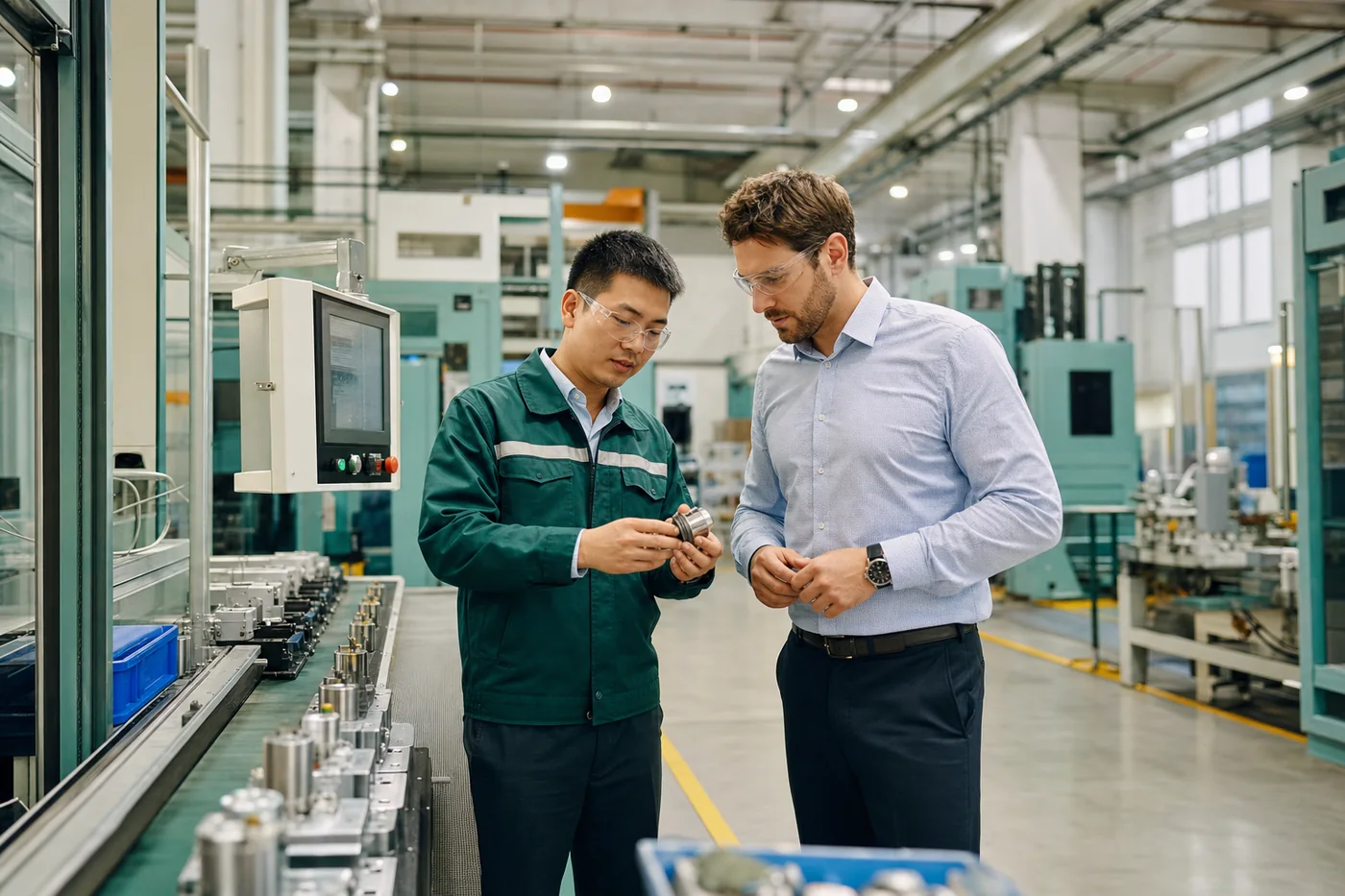
A live video call can provide useful preliminary evidence. Ask to see the entrance, company signage, production areas, relevant machinery, raw materials, quality-control points and packaging activity. The person showing the site should be able to answer practical questions about the product and process.
For commercially significant orders, consider appointing an independent inspection provider or suitable local specialist. The scope should be agreed in advance because a general factory visit is different from a technical audit, social-compliance audit or pre-shipment product inspection.
7. Check that the payment details make commercial sense
Compare the beneficiary name and country on the payment instructions with the contracting and invoicing entities. If payment is requested to another company or jurisdiction, ask for a documented explanation and assess the arrangement before sending funds.
Be particularly cautious about unexplained last-minute changes to bank details. Confirm any change through a previously verified communication channel and apply your own financial controls.
Common warning signs
- The supplier avoids sharing its full legal company details.
- Registration, quotation, contract, invoice and bank names do not align.
- The factory address or production role changes during discussions.
- Technical questions receive vague or repeatedly delayed answers.
- A live factory review or independent visit is continually postponed.
- Pressure is applied for rapid payment before the commercial structure is clear.
A transparent intermediary can still add value
Working through a sourcing or trading partner can be appropriate when that role is clear. A transparent partner should explain how it is paid, identify the relevant contracting and producing parties, document responsibilities and coordinate independent checks where required. The concern is not the presence of an intermediary; it is uncertainty about who controls production and who is accountable.
How Peak Point can support the process
Peak Point can support UK businesses exploring sourcing opportunities in China by coordinating prospective supplier research, communication, quotations, samples, production follow-up, independent inspection enquiries and international freight planning through appropriate partners.
These checks reduce uncertainty but cannot eliminate commercial risk or guarantee a supplier, product or transaction. Clients retain responsibility for supplier selection, product suitability, contractual commitments and payment decisions. Legal, tax, customs, compliance and technical matters should be reviewed by appropriately qualified specialists where required.